Piece of Dominican Blue Amber as seen in the rough
Amber is supposed to be amber color, right? Not exactly. There is the original colors of Amber, yellow, orange, honey, cognac or similar. A new delight among jewelry designers is Butterscotch Amber, found in the Baltic as well as the Middle East. But there also is cream, cherry, red, green and even blue, which is by far the rarest of all the Ambers. Up to this day many people do not believe in the existence of "BLUE" amber. Must be something in the air or in the ground, since two of the more highly prised gemstones that come from the Dominican Republic are both "BLUE" - Blue Amber and Larimar.
Chunk of Dominican Amber with Reds-Cognac-Yellow coloring.
Is Blue Amber Truly Blue? No. It is not. And yet, it is. Confused? Blue Amber is a result of fluorescence and no solid color exists. Ultra-violet or violet light is re-emitted as blue or green light, attributed to the presence of poly-nuclear aromatic molecules. Therefore, Blue amber is blue, but not the way you might think.
When sunlight strikes the Blue Amber on a white surface the light particles pass right through and are refracted by the white surface. Result: the Blue amber looks almost like any other Amber, only with a light blue hue. But when the light particles can't pass through and refract back, the hydrocarbons in the Blue Amber turn the sun's ultraviolet light into blue light particles. The result: the famous blue glow of Blue Amber. This effect is only possible with Dominican Blue Amber pieces graded within the Blue Amber category. Any other Amber (like Baltic and others) will not display this blue phenomenon at all. And, on top of that other Dominican Amber will show this blue efraction only in concentrated UV light, and not in natural light. Light passed through the Blue Amber from a flashlight, will also result in the normal looking cognac amber color.
Example of same piece of Blue Amber with front lighting, then looking as same piece lighted from the reverse
Thanks to The Amber Ranch for the pieces of and the info on Dominican Blue Amber


Rhodochrosite (whose name means rose-colored) is a very attractive mineral with an absolutely one-of-a-kind, beautiful color. Although it can be an ore of manganese, it is its ornamental and display specimen qualities that make it a very popular mineral. The color of a single crystal can just astound the observer with its vivid pink-rose color that seems to be transmitted out of the crystal as if lit from within. Individual crystals are found in well shape rhombohedrons and and sometime in rarer scalahedrons. In a massive form its pink and white bands are extremely attractive and are often used in semi-precious jewelry. Rhodochrosite is often carved into figurines and tubular stalactitic forms are sliced into circles with concentric bands that are truly unique in the mineral kingdom.
Fine crystals are sometimes cut into gemstones, but Rhodochrosite's softness and brittleness limit it as a gemstone for everyday use. Identification of Rhodochrosite is fairly easy despite a few similarly colored minerals such as Rhodonire. Rhodonite is harder and has different cleavage; but perhaps the best distinguishing factor is its lack of reaction to acids. Rhodochrosite will easily with show some reaction to cold acids which demonstrates its carbonate chemistry. Basically, any rose-pink carbonate is considered Rhodochrosite; however some Calcites with a small amount of manganese impurities can be pink in color. The manganese replaces some of the calciums in calcite but a complete series between Calcite and Rhodochrosite is not established. There are many localities for Rhodochrosite that are of great reknown.
Beyond a doubt, the best locality for Rhodochrosite is the Sweet Home Mine in Colorado. It is unmatched for its superb Rhodochrosite crystals that exhibit the best features of the species; a fine bright rose color and sharp well formed crystals. Some specimens from here are quite large and of world class distinction. Other localities have produced some fine specimens as well. Catamarca, Argentina has an old inca silver mine that has produced fine stalatitic examples of Rhodochrosite that are unique and very attractive. Cut cross-sections reveal concentric bands of light and dark rose colored layers. These specimens are carved and used for many ornamental purposes.
A whole table of Rhodocrosite at a Gem Show, however just one small specimum from the Sweet Home Mine in Colorado. Most of the specimums were from Argentina.
synthetics) into decorative items such as engraved gems, including cameos, or cabochons, and faceted designs. Hardstone carving is the term in art history for the objects produced and the craft. Diamond cutters are generally not referred to as lapidaries, due to the specialized techniques which are required to work diamond. Gemcutter typically refers to diamond cutters or producers of faceted jewels in modern contexts, but artists producing engraved gems, jade carvings and the like in older historical contexts. The arts of a sculptor or stonemason do not generally fall within the definition, though chiseling inscriptions in stone, and preparing laboratory 'thin sections' may be considered lapidary arts.
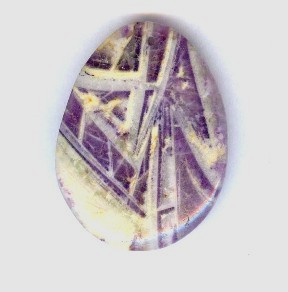
then tends towards the well known and very popular purple February Birthstone gemstone called Amethyst.
Some will also think of the gemstone Ametrine, which is a unique dual gemstone of Amethyst and Citrine.
Lepodolite is a lilac-gray or rose-colored phyllosilicate mineral in the mica group that is a secondary source of lithium. It is associated with other lithium-bearing minerals like Spodumene in pegmatite bodies. It is one of the major sources of the rare alkali metals rubidium and caesium. It occurs in granite pegmatites, in some high-temperature quartz veins, greisens and granites. Notable occurrences include Brazil, Russia, United States,Canada and Madagascar.
Sugilite (also known as Luvulite) is a relatively rare pink to purple cyclosilicate mineral. Sugilite crystallizes in the hexagonal system with prismatic crystals. The crystals are rarely found and the form is usually massive. It is mostly translucent but can be opague when mixed with a host rock. Sugilite was first described in 1944 for an occurrence on Iwagi Islet, Japan, where it is found in an aegirine syenite intrusive rock. It is found in a similar environment at Mont Saint-Hilaire, Quebec, Canada. In the Wessels mine in northern South Africa, Sugilite is mined from a strata-bound manganese deposit. It is also reported being found in Italy, Australia and India.
Sodalite is a light, relatively hard yet fragile mineral named after its sodium content; in mineralogy it may be classed as a feldspathoid. Well known for its blue color, Sodalite may also be grey, yellow, green, or purple and is often mottled with white veins or patches. The more uniformly blue material is used in jewelry but the fashionable purple variety hold the greatest attention. It is normally fashioned into cabochons for pendants and beads. Lesser grade material is more often seen as facing or inlay in various applications. Although somewhat similar to Lazurite and Lapis Lazuli, Sodalite rarely contains Pyrite and its blue-purple color is more like traditional royal blue than ultramarine. It is further distinguished from similar minerals by its white (rather than blue) streaks. Sodalite's six directions of poor cleavage may be seen as incipient cracks running through the stone.
And last but not least we have to consider our tried and true gemstones made out of Agate. In one specific location in the Campo Morado area of Mexico, south-southwest of Mexico City, there is a very purple colored Agate. It is a naturally colored purple Agate called the Morado Agate. But as with many other Agates and Jaspers, buyer beware because many are dyed and purple is one of the favorite colors.
Most Geodes are derived from strata of the lower Warsaw Formation, a widespread rock unit of Mississippian age. Muds deposited in a shallow sea about 340 million years ago were primarily calcium carbonate and clay, and were subsequently lithified to form the shales, shaley dolomites, and limestones that we see today. Collecting Geodes can be both fun and educational. Once you've located exposures of lower Warsaw strata or a Geode-bearing stream course, all that's required is a little patience and a good bricklayer's or rock hammer. A sharp blow with a hammer is usually sufficient to crack open individual Geodes, exposing their crystalline interiors to daylight for the first time. However as a Warning, remember that most Geode-collecting localities are now on private land, and written permission must be secured before entering and collecting the Geodes.
Fossil Coral is a natural stone primarily found in Indonesian water that is formed when ancient Coral is gradually replaced with Agate. The proper name for this material is "agatized coral" or "agatized fossil coral". The fossilized coral typically appears as small flower-like patterns in the stone.
Corals are among the most colorful animals in the sea. Most corals live in warm, shallow, tropical seas and feed on plankton. The oldest fossil corals are from the Ordovican period, over 450 million years ago. Corals are marine animals with a sac-like body, mouth, tentacles and skeleton. It is the skeleton that survives in the fossil record. Corals may be solitary or found in large colonies.
Under unique geological conditions, prehistoric corals and mollusks can fossilize by being replaced with agate from silica-rich ground water percolating through limestone. Of the varieties of fossilized corals found throughout the world exquisitely detailed specimens from the mountains of Indonesia are among the most unique. In Indonesia, entire coral heads are often completely preserved and appear just as they did 20 million years ago, although their density is much changed by replacement with silica, iron, manganese and other minerals. There are fern corals, brain corals, hex corals, honeycomb corals and many more.
Florida and Georgia in the USA are also import sources of fossil coral. In fact Florida has declared fossil coral to be the Florida State Rock.
This highly unusual stone called Print Stone or Newsprint Jasper, comes from an area near Kununurra in North Western Australia. Actually it is a type of Silicated Sandstone which as can be seen has an increible pattern. 

Sea Glass, not a gemstone, not natural, but is one of the very few cases which a valuable item has been created from the actions of the environment on man-made litter..
Sea glass (known by many varied names the world over - some of the more common being beach glass, mermaid's tears, lucky tears, sea tears) is usually found on beaches along oceans or large lakes that have a lot of wave action which causes the glass to have been tumbled and smoothed by the water and sand, creating small pieces of smooth, frosted glass. Do not be pulled in by some of the newly created man-made frosted glass being sold by dealers claiming that it is Sea Glass.
.

The color of sea glass is determined by its original source. Most sea glass comes from bottles, but it can also come from jars, plates, windows, windshields, glasses, art, flasks, containers, and any other glass source that has found its way into the ocean. Some collectors also collect what is known as sea pottery. Many very interesting jewelry pieces can be made out of the collected Sea Glass.
The most common colors of sea glass are kelly green, brown, and clear. These colors come from bottles used by companies that sell beer, juices, and soft drinks. The clear or white glass comes from clear plates and glasses, windshields, windows, and assorted other sources. Some less common colors include jade, amber (from bottles for whiskey, medicine, spirits, and early bleach bottles), golden amber (mostly used for spirit bottles), lime green (from soda bottles during the 1960s), forest green, and soft blue (from soda bottles, medicine bottles, ink bottles, and fruit jars from the late 1800s and early 1900s, windows, and windshields.) These colors are found about once for every 25 to 100 pieces of sea glass found.
One might rarely see sea glass which comes primarily from early to mid-1900s Coca-Cola, Dr Pepper, and RC Cola bottles, as well as beer bottles. Seaq glass which is hardly ever seen, but when found is a golden treasure is purple, citron, opaque white (from milk glass), cobalt and cornflower blue (from early Milk of Magnesia bottles, poison bottles, artwork, and Bromo-Seltzer and Vicks VapoRub containers), and aqua (from Ball Mason jars and 19th century glass bottles.) These are a one in a thousand find. An extremely rare color is black. The black glass is quite old, originating from thick eighteenth-century gin, beer and wine bottles, maybe one in a ten-thousand find.
Anyone that is really interested in Sea Glass should check out the North American Sea Glass Association at http://seaglassassociation.org/ for more information and collectors near your location.At this time, Jewelry by CnC has not yet used Sea Glass in any of our designs.
Black corals (Antipatharia) are a group of deep water, tree-like corals related to sea anemones. Although the most famous are found near Hawaii, they are also found in rare dark shallow water areas such as New Zealand's Milford Sound where they can be viewed from an underwater observatory. They normally occur in the tropics and some have ben found in the Caribbean. Though black coral's living tissue is brilliantly colored, it takes its name from the distinctive black or dark brown color of its skeleton. Also unique to black coral are the tiny spines that cover the surface of the skeleton, the origin of the nickname little thorn coral. In the Hawaiian language, black coral is called ‘Ä“kaha kÅ« moana. Black coral is listed in Appendix II of the Convention on International Trade in Endangered Species (CITES).
To ensure the future of Hawaiian Black Coral, divers must strictly adhere to state regulations that prohibit the harvesting of immature colonies. Harvesting of Black Coral is prohibited in most locations in the world.
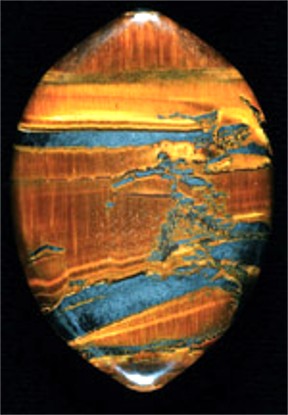
Tiger’s Eye is a chatoyant gemstone that belongs to the Quartz family. It is normally a metamorphic rock which is yellow to red-brown in color with a silky luster. Chatoyancy is a changing in the luster or color of a gemstone as light is reflected within the thin parallel fibrous bands. The fibrous structure of the material is what causes this effect to happen. Tiger's Eye gemstones are normally cut into various cabochon shapes to best display their chatoyancy. Tiger's Eye can also show a Cat's Eye effect.
Tiger's eye is derived from Crocidolite (a mineral comprised of iron and sodium) which has been oxidized to a golden brown from its original blue color and the Crocidolite has been totally replaced by Quartz. An incomplete silicified process producing a blue variant is known as Hawk’s eye.
The rarer blue Hawk's Eye will have only the slightest amounts. Tiger's Eye is also called a Cat’s Eye Quartz when the color is greenish grey. It is called Tiger’s Eye Cat Eye when the brown stone reflects a golden yellow stripe and if the stone is bluish or blue gray, then it is known as Hawk's Eye Cat Eye. The rare mahogany or any redish colored stones are known as Ox Eye or Bull's Eye.
Now we throw in a confusion factor for identification. Tiger Iron is a composite gemstone of black Hematite, red Jasper and Tiger's Eye. It has rippled wavy bands of color often which resemble a scenic view. It usually has a greenish cast with shades of golden yellow, brown and reds. Marra Mamba is a form of Tiger Iron that was found only in a specific area of Australia near Mount Brockman. It is a very rare type of Tiger Iron that contains shades of green, red, blue and yellow. Since the area has been mined out for many years, very little of the "true" Marra Mamba is available in todays markets. If you want to see some, find a good collector or a museum that might have some.
Tiger’s Eye is often heat treated in which any changes are permanent, therefore no extra care is needed, but just like any other gemstone it should be protected from sharp blows, heavy scratches and large temperature changes. Quartz dust can be hazardous to breathe according to several recent research studies. Since the fibrous mineral in most Tiger's Eye has been completely replaced by Quartz, it is best to take adequate precautions to avoid breathing any of the dust when cutting or polishing Tiger's Eye, or any oher Quartz stone.
The fibers in Tiger's Eye are very thin and may only be an inch or two long. Most are only 0.001 millimeters, in diameter. Since Tiger’s Eye normally has bend or twisted fibers, sawing can be tricky and cuts must exactly parallel to the length of the fibers in order to get the full chatoyant effect. You will end up with a lifeless, dark brown to black worthless stone if the saw cut is perpendicular to the fibers. Very careful cutting and polishing is required to line all the fibers up to get a true cat-eye effect.
So as not to raise to much confusion or start an arguement over what is Michigan's selection, one needs to also know that Michigan's State Stone, which is much better known, especially to Lapidarist, is 'The Petoskey Stone'. Petoskey Stones are masses of fossil colony coral, Hexagonaria Percarinata. They occur abundantly in Devonian reef limestones of the Traverse Group in the northern part of the Southern Peninsula of Michigan. The Devonian Period was about 350 million years ago. Coral groups weathered out of the limestone were widely scattered by Pleistocene glacial action. They are readily found on beaches and in gravel deposits as pebbles and cobbles rounded by erosion. Petoskey is the English adaptation of either "Be-dos-e-gay" or "Petosegay," an Ottawa Indian word and variant meaning "sun rays of the dawn."