
When one talks about gemstones and the color purple is mentioned, normally the conversation  then tends towards the well known and very popular purple February Birthstone gemstone called Amethyst.
  Some will also think of the gemstone Ametrine, which is a unique dual gemstone of Amethyst and Citrine.
 then tends towards the well known and very popular purple February Birthstone gemstone called Amethyst.
  Some will also think of the gemstone Ametrine, which is a unique dual gemstone of Amethyst and Citrine.
But there are some other purple colored gemstones that can also be used to make some very colorful and unique jewelry pieces. Four additional purple colored gemstones that are used quite often in jewelry are listed below.
 Lepodolite is a lilac-gray or rose-colored phyllosilicate mineral in the mica group that is a secondary source of lithium. It is associated with other lithium-bearing minerals like Spodumene in pegmatite bodies. It is one of the major sources of the rare alkali metals rubidium and caesium. It occurs in granite pegmatites, in some high-temperature quartz veins, greisens and granites. Notable occurrences include Brazil, Russia, United States,Canada and Madagascar.
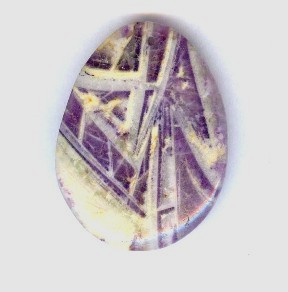 Sugilite (also known as Luvulite) is a relatively rare pink to purple cyclosilicate mineral. Sugilite crystallizes in the hexagonal system with prismatic crystals. The crystals are rarely found and the form is usually massive. It is mostly translucent but can be opague when mixed with a host rock. Sugilite was first described in 1944 for an occurrence on Iwagi Islet, Japan, where it is found in an aegirine syenite intrusive rock. It is found in a similar environment at Mont Saint-Hilaire, Quebec, Canada. In the Wessels mine in northern South Africa, Sugilite is mined from a strata-bound manganese deposit. It is also reported being found in Italy, Australia and India.
 Sodalite is a light, relatively hard yet fragile mineral named after its sodium content; in mineralogy it may be classed as a feldspathoid. Well known for its blue color, Sodalite may also be grey, yellow, green, or purple and is often mottled with white veins or patches. The more uniformly blue material is used in jewelry but the fashionable purple variety hold the greatest attention. It is normally fashioned into cabochons for pendants and beads. Lesser grade material is more often seen as facing or inlay in various applications. Although somewhat similar to Lazurite and Lapis Lazuli, Sodalite rarely contains Pyrite and its blue-purple color is more like traditional royal blue than ultramarine. It is further distinguished from similar minerals by its white (rather than blue) streaks. Sodalite's six directions of poor cleavage may be seen as incipient cracks running through the stone.
 And last but not least we have to consider our tried and true gemstones made out of Agate. In one specific location in the Campo Morado area of Mexico, south-southwest of Mexico City, there is a very purple colored Agate. It is a naturally colored purple Agate called the Morado Agate. But as with many other Agates and Jaspers, buyer beware because many are dyed and purple is one of the favorite colors.


