Pages

Showing posts with label Gemstone Jewelry. Show all posts

Monday, March 19, 2012

Texas Topaz Day - Mason, Texas - Mar 24-25, 2012

This coming weekend the Southwest Gem and Mineral Society in San Antonio and the World Gem Society invites everyone to come to Mason, Texas, to join in the Texas Topaz Day festivities on Saturday, March 24th, followed by the Texas Faceters Guild Seminar Day on Sunday, March 25th. Mason, Texas, right in the heart of the Texas Hill Country is located in some of the most interesting geological formations to be found anywhere in the world. The festivities and events start at 10:00 am on Saturday and run all day with gemstone cutting and faceting demonstrations, jewelry and arts shows, and contests and music events to cap off the day. Then on Sunday you can join the Texas Faceters Guild for a day of learning about the latest in gemstone cutting and faceting. From novice to expert all are welcome.


The Blue Topaz was adopted as the Texas State Gemstone as a result of legislative approval on March 26, 1969. Petrified Palmwood was also named the State Stone by the same legislation. This Swiss Blue Topaz just above has been given a special cut to show the Texas Lone Star. A limited supply of these will be available over the two days in Mason, Texas.


Topaz occurs naturally in many colors including blue, orange, brown, green, pink, beige and red. Naturally occuring Blue Topaz is quite rare. Colorless topaz, the most common variation, can be treated by irradiation to produce a wide range of shades of blue, which are known as Sky Blue, Swiss Blue and London Blue. This treated, Blue Topaz is one of the most popular and widely used of all gemstones. London Blue is the most famous and most highly prized, but takes over 18 months to produce. Radiation scares have centered around the process and lasting effects from the making London Blue Topaz.


Some clear topaz crystals from Brazilian pegmatites can reach boulder size and weigh hundreds of pounds. Crystals of this size may be seen in museum collections. One famous Topaz is The Topaz of Aurungzebe and weighed 157.75 carats. Colorless and rarely light-blue varieties of Topaz are found in Precambian granite in Mason County, Texas, within the Llano Uplift in the Streeter, Grit, and Katemcy areas. It is usually found in streambeds and ravines but occasionally can be located atop the ground. Currently, only three Mason County ranches offer the public the opportunity to go Topaz hunting. They charge by the day, you keep what you find. You can enjoy Topaz hunting throughout the year except during the months of November, December and early January, when the ranches are closed for the deer season. There is currently no commercial mining of Topaz in that area. The natural Blue Topaz found in this area is the scarest of all the Topaz varieties.

Topaz is also the Birthstone for the month of November.


So as not to confuse the Lapidary enthusiasts, the Official State Rock of Texas is also Petrified Palmwood.
.

Monday, November 21, 2011

The Peddler's Show - Fredricksburg, Texas !


The Peddler's Perfect Street of Shops


The shopping experience designed to be as individual and unique as you!


For the past 34 years, The Peddler Show has offered Texas shoppers a truly remarkable and one-of-a-kind shopping experience. There are currently 25 shows annually. Shoppers will find a vast selection of exclusive items including personalized designs, home décor, hand crafted fashionable jewelry, fashionable clothing, gourmet treats, creative gifts and so much more!. And each year discover an new array of hot fashions, trendy jewelry, stylish home furnishings, unique gift items, gourmet foods and much more.

Admission to Gillespie County Fairgrounds on Highway 16 South of Fredricksburg is $5 for adults, $3 seniors 65 + and children 12 and under free.


Hours are Friday 25th from 1:00 - 9:00PM


Saturday 26th from 9:00AM - 6:00PM


Sunday 27th from 11:00AM - 4:00PM

Please call 512/358-1000 for more information.


Jewelry by CnC


will be located in the Pavilion

Tuesday, November 15, 2011

Freeman Coliseum Holiday Extravaganza !


--- DESIGNS by GAYLE ---


Come to the Freeman Coliseum Holiday Extravagamza and see these new items by Jewelry by CnC


These designs incorporate rough cut freeform gemstones, simlar as to how they come out of the ground but cleaned up and surrounded with a pressed silver frame. Other natural minerals/gemstones which have been wire-wrapped will also be available.


Jewelry by CnC will be located in Booth O-4 on the Coliseum Main Floor.


The Holiday Extravaganza is open


Saturday Nov 19th 9 to 5


Sunday Nov 20th 10 to 5

Tuesday, September 13, 2011

Coral Fossils for Jewelry !


Natural Coral Fossil cut as a Pendant


Corals are simple animals that secrete skeletons made of calcium carbonate. They are close relatives of sea anemones and jellyfish and are the main reef builders in modern oceans. Corals can be either colonial or solitary.

.
As fossils, corals are found worldwide in sedimentary rocks. Based on these fossils, we know that the corals began their long evolutionary history in the Middle Cambrian period, over 510 million years ago. In Kansas, they were deposited from about 315 to 250 million years ago. Nice coral fossils are found in Pennsylvanian and Permian rock formations. Although corals are the main reef builders in modern oceans, not all corals build reefs. In addition to the corals, which are called framework organisms, other organisms contribute to the formation of reefs. For example, modern reefs are inhabited by binding organisms (such as encrusting algae) and filler organisms (such as snails, bivalves, and sponges), whose skeletons fill in the spaces in the reef after death.

.
Two groups of corals were important inhabitants of the Pennsylvanian and Permian seas--tabulate and rugose corals. Tabulate corals were exclusively colonial and produced calcium carbonate skeletons in a variety of shapes: moundlike, sheetlike, chainlike, or branching. Tabulate corals get their name from horizontal internal partitions known as tabulae. Some tabulate corals were probably reef builders..
...


Pink Coral Fossil and Indonesian Coral Fossil are among the most commonly found Coral Fossils used in todays jewelry.


Coral fossil material displays the unusual internal structure of the original coral. Coral fossil cuts and polishes like Agate, but in most cases are a bit softer.


.
......


Red Eye Coral and Black Eye Coral are two of the more unusual types of Coral Fossil found in present day markets. Both come from sea floors around South East Asia.


.


Sponge Coral ! That's its trade name. It is known to marine biologists as melithaea ochrace. A sponge coral really has nothing to do with sponges. It just looks like a sponge. Found mainly in the South China Sea, from Taiwan down to Indonesia, the sponge coral has a distinct fan-shaped appearance underwater. Until recently, sponge coral was not used for jewelry as they weren't considered jewelry-quality coral because they contained too many holes. However with the "farming" of man-enhanced Sponge Coral, we now have a renewable source and thus the harvesting and use of other natural corals is becoming more and more controlled, even to the extent that importation of coral is illegal into many countries without special government issued licenses, however Sponge Coral does not fall under these regulations. The majority of Sponge Coral used in jewelry has to date been shades of reds and oranges.


A very rare pure White Coral Fossil.


The coral can be cut and placed into very fine jewelry, such as this Black Coral ring. However, coral is best used in earrings and pendants, as its softness can allow it to be easily damaged in jewelry such as rings, unless properly protected.


..


And of course in todays market place we have all kinds of fakes and man made gemstones. Although natural, colored coral fossil stones are normally found to have been helped a bit with some colorations from man.

Sunday, September 11, 2011

Michigan's 'Green Turtle Stone' - "CHLORASTROLITE" !


YES, there is a stone known as the "Green Turtle Stone" It was not made up by some kids to cause a sensation.

In 1972, Chlorastrolite became the official State Gemstone for Michigan. Chlorastrolite is a beautiful green mineral with a chatlyant "turtle-back" pattern. Don't feel too bad if you are unfamiliar with the name. First of all, it is quite uncommon. Gem varieties are only found in Michigan. Secondly, there has been some confusion over the correct name as well as its true identity. It has been considered to be a Zoisite, a variety of Prehnite and a variety of Thomsonite. It has been called lotrite, kearsargeite, zonochlorite, lintonite, pumpellyite, chlorastrolite and greenstone. After much research, the IMA has ruled that the gem we are talking about is to be called "Chlorastrolite," - Michigan collectors still call it by the common name, "greenstone" or "Turtle Stone".

.
Chlorastrolite occurs in the basalt layer deep under the Keweenaw Peninsula. When Isle Royale was formed off-shore from Keweenaw by an upheaval of the bedrock under Lake Superior, some of this material was brought to the surface. This tilting of the bedrock exposed the greenstone-bearing basalt. Wave action erodes the greenstones free and they may be found as beach gravel on the Isle. For many years this was thought to be the only source of the gem. When first offered in jewelry by the NewYork fashion stores in the 1890s, they were referred to as "Isle Royale Greenstones." To this day, many persons fail to realize that much of the Chlorastrolite occurred under the Keweenaw Peninsula and was discarded on mine dumps by the copper miners when they tunneled to the copper. The mines are not operating now and new material is not being brought to the surface, but the greenstones are usually overlooked by the rockhounds searching for copper. You can find gem-quality Chlorastrolite at the mine dumps if you look carefully. Greenstones have been found at most of the mines at Keweenaw; however, some mines produce better greenstones than others. The Central Mine, located just off US 41 north of Calumet, has been the most recent source of some of the largest greenstones.

.


So as not to raise to much confusion or start an arguement over what is Michigan's selection, one needs to also know that Michigan's State Stone, which is much better known, especially to Lapidarist, is 'The Petoskey Stone'. Petoskey Stones are masses of fossil colony coral, Hexagonaria Percarinata. They occur abundantly in Devonian reef limestones of the Traverse Group in the northern part of the Southern Peninsula of Michigan. The Devonian Period was about 350 million years ago. Coral groups weathered out of the limestone were widely scattered by Pleistocene glacial action. They are readily found on beaches and in gravel deposits as pebbles and cobbles rounded by erosion. Petoskey is the English adaptation of either "Be-dos-e-gay" or "Petosegay," an Ottawa Indian word and variant meaning "sun rays of the dawn."

.
.

Tuesday, August 16, 2011

VARISCITE - Yes it comes in RED !

Variscite is a hydrated aluminium phosphate mineral. It was at one time considered to be a relatively rare phosphate mineral. Because most Veriscite comes from close bye or the same location, it is sometimes confused with Turquoise; however, Variscite is usually much greener in color. Variscite is a secondary mineral formed by direct deposition from phosphate-bearing water that has reacted with aluminium-rich rocks in a near-surface environment. It occurs as fine-grained masses in nodules, cavity fillings, and crusts. Variscite often contains white veins of the calcium aluminium phosphate mineral Crandallite.

..
Variscite is sometimes used as a semi-precious stone, and is popular for carvings and ornamental use. It was first described in 1837 and named for the locality of Variscia, in Germany, the historical name of Vogtland. In 1894 Variscite was found near Fairfield, Utah, and given the name Utahlite. Later in the early 1900s Variscite was found in Nevada. Variscite is known for its bright to dark green coloration. The Navada Veriscite is also known for it black spider web colorations within the material.


Fine carving and pendants have been made from the beginning out of the green Variscite. Pendants can be almost entirely the green Variscite or they can have streaks of the Variscite running through the host stone, similar to Boulder Opal and Boulder Turquoise, thus why sometimes the confusion.


A surprise to many, an unusual red variety of variscite occurs in certain Precambrian iron ores in the Middleback Ranges of South Australia. As with many gem and mineral findings in Australia, and in this Iron Monarch deposit, apatite in the hematite ores oxidized, leading to the formation of a large suite of secondary phosphates. Among these occurs variscite, which forms crystalline coatings on hematite surfaces, rarely associated with other phosphate minerals. The variscite contains approximately 10 percent iron. Amazingly the variscite from the Iron Monarch quarry is deep rose-red and transparent. It occurs in globular surface coatings consisting of small blocky crystals. Because of the black matrix and the transparency of the crystals, their overall appearance is dark cherry-red. Deposits of this same Red Veriscite material have now been found in Brazil and and pink variety in the Wood Mine, Cocke County, Tennessee.


Larger deposits of the Australian Red Veriscite allow for the formation of nice sized rocks that when cut, make for a beautiful Red Veriscite cabochon or pendant.
..


.

This Red Veriscite must not be confused with the Red River Jasper which also comes from Australia.


Also definitely don't confuse Veriscite with colored Sea Sediment Jasper from Indonesia.


Friday, December 3, 2010

Christmas Extravaganza at Live Oak Civic Center !

Jewelry by CnC


is located in


Booth 910, left of Snack Bar along the rear wall.


.

Come and see new designs such as this Turquoise, Tiger Iron and Crystal Set.

.

Thursday, December 2, 2010

San Antonio LIve Oak Christmas Extravaganza!

New Sets from Jewelry by CnC
for the
17th Annual Christmas Extravaganza at Live Oak Civic Center
.

Spiderweb Agate Pendant, Carnelian, Jade, Crystals & Pewter Set
.
Enamel/Copper Pendant, Sponge Coral & Copper Set
.
Turquoise, Pipestone, Crystals & Copper Set
.
Live Oak Civic Center
December 4th & 5th
Saturday & Sunday: 10:00am – 5:00pm (both days)
.

Wednesday, November 17, 2010

Freeman Coliseum Christmas Showcase 2010


Time to do some Holiday shopping in the San Antonio Area
.
This coming weekend will be a great time
.
31st Annual San Antonio Christmas Showcase
Freeman Coliseum
Saturday, November 20 - Sunday, November 21
Hours: Sat - 9am-5pm & Sun - 10am-5pm
.
The Timeless Designs booth is located in the Coliseum, main floor under the alcove!
.
Avoid the lines and traffic at the malls; come join us for the show of the season!! We will have all new artisan crafted jewelry collections featuring.....
.
Southwest Flair; classic and modern styles in turquoise, coral, magnesite, and onyx
Natural stones, glass and dichroic necklace sets from Jewelry by CnC - Gayle
Mystic Artisan; high-end elegance in agate, jasper, pearl, dichroic glass, Swarovski crystal, and more
Wiry Legend; funky wire techniques in links, swirls, wraps, cages, and use of other metals
Pendants; mounted single, wired and unmounted singles with cords from Jewelry by CnC
Rock Yard; old earth comes to life using fossils, minerals and raw rocks
.
Year End Close-out Holiday Sale Items - Timeless Designs & Jewelry by CnC
........and so much more!
.
So grab your list, put on some comfy walking shoes and join the holiday shopping festivities with over 500 booths to shop from featuring some of Texas's most talented artists!
.
Hope to see you there!!
Annette Cook - Timeless Designs
Gayle & Lee Cook - Jewelry by CnC


Thursday, November 4, 2010

Cokerfest Arts & Craft Show

Dichroic Glass and Turquoise Beads Set
.
For our Friends and Customers in the San Antonio Area
.
Come join Jewelry by CnC at the
.
2010 Cokerfest Fall Arts & Crafts Show
.
Saturday, November 6th
9:00 am - 4:00 pm
Coker United Methodist Church
231 E. North Loop Road (281/Nakoma)
Our booth is located in the Wesley Building
.
Dichroic Glass Pendant on Royal and Cape Amethyst Necklace Beads Set
.
Designs featuring hand-crafted jewelry using crystals, and natural stones!
.

Wednesday, October 27, 2010

ROLLING OAKS MALL - October Mall Market Days !

On October 29th, 30th and 31st come and visit San Antonio's Rolling Oaks Mall for the 4th Mall Market Days of 2010. Rolloing Oaks Mall is located on the north east side of San Antonio at the intersection of Loop-1604 and Nacogdoches Road.
For our San Antonio and Hill Country area friends and customers, please come and visit our booth in the mall during the three day event during normal mall hours. Plan on seeing the following new designs by Gayle, as well as many more not shown on the BLOG .
.

Stop bye and say Hello and let us know you saw these items on the BLOG.
.
.

Tuesday, September 28, 2010

ENCINO PARK 2010 FALL CRAFT FAIR !

Come and join us on Sat Oct 2nd or Sun Oct 3rd from 9AM until 5PM at the Encino Park Women's Club 2010 Fall Craft Fair.
.
The Craft Fair will be held in the Encino Park Community Center

1923 Encino Rio ( just east off of US-281 north of 1604)
.

2009 Encino Park Craft Fair Booth

.

Look for our Jewelry by CnC sign in the main Community Center room at Location 5 & 6

.

Tuesday, September 21, 2010

ROLLING OAKS MALL MARKET DAYS - Sep 24, 25 & 26, 2010 !

San Antonio's Rolling Oaks Mall will again be the scene for the 2nd Mall Market Days for 2010. During normal Mall operating hours on September 24th, 25th and 26th, special vendor booths have been added throughout the mall for craftmen, jewelry makers, candle makers and others to show off and sell their items for the upcoming Holiday Season. Be sure to stop bye and see us at the Jewelry by CnC booth during one of the three days.
.
Rolling OaksMall is located on the North East side of San Antonio, just west of I-35 on Loop 1604, and east of US-281 at the Nacogdoches Road exit on the north west corner of Loop-1604.

.
.

Friday, September 10, 2010

The Fragil "Mystic" Topaz

One of the most beautiful gemstones currently on the market is the "Mystic" Topaz. You can find one in some 64 known colors and probably a few more on Cruise Ships that haven't been advertised. One thing not always stressed to the buyer of all varieties of "Mystic" Topaz is the fact that "Mystic" Topaz is nothing more than colorless topaz that has been subjected to a vapor deposit process by which a variety of secret ingredients are coated on the surface of the stone creating the various colors and sparkle. There is no "Mystic" Topaz mine, but there is a fabulous "Mystic" Topaz manufacture that I linked to a couple years ago on my web-site at http://www.jewelrybycnc.com/ that is still in business, and you can browse his site at http://www.mystictopaz.com/ to view many varieties of "Mystic" Topaz as well as many other gemstones.

The real problem with "Mystic" Topaz is not just that it easily scratches, but that it is also very fragil, to the point that it can be damaged by a jeweler's tweezers during setting and especially resetting, any kind of normal wear and tear, and even heat and cold. But another real problem is that you cannot clean the stone.

Below you see two images. At one time these two stones were identical in color. But one was placed in a normal jeweler's ultrasonic cleaner with the same ammonia and water solution that is sold as jewelry cleaner around the world. You can see that in a very short period of time all of the coating was removed by the ultrasonic cleaner. Meaning that any mystic topaz gemstone set in any kind of ring with diamonds or other gemstones can never be properly cleaned. The only option is a cursory cleaning in plain water, maybe with a small amount of Dove Soap. Which by itself will not remove things like hand lotion, body oils, and perfumes. Meaning that once your mystic topaz ring gets dirty, you are pretty much stuck with a dirty ring.


Probably 98% of all gemstones are treated in some form or another, heat, dying, radiation, infusion, etc. Without treatments, the available number of gemstones on the market would be greatly reduced. And as long as treatments are properly disclosed to consumers, they present many valuable streams of revenue to the independent retail jeweler around the world.

But this craze over Mystic Topaz has just gone a bit overboard. The treatment is too fragile to be viable. There is just too much promotion going on that leaves out the fact that this treatment is temporary, at best. The coating can be flaked off by your fingernail. It cannot withstand heat or cold. And more important, it cannot be properly cleaned after being set into jewelry items with other gemstones. But "Mystic" Topaz is beautiful, and certain manufactures are now claiming that their treatment procedures are becoming more perimenent. Hopefully if one acquires a "Mystic" Topaz, no matter what color, it is of the newer and more perminent coloration nature.


An original green colored "Mystic" Topaz.


Friday, September 3, 2010

Metal Clay in Jewelry Making !

For many jewelry makers who have dreamed of working with metal but have had nightmares about using the torch, Metal Clay, also called Precious Metal Clay (PMC) and Art Clay, may be their dream come true. However, keep in mind that while you don't need to use a torch to necessarily solder metals together, it can be helpful to know a little about metal work in order to clean and finish metal clay pieces.
..
Metal clay is a clay-like medium used to make jewelry, beads and small sculpture. It consists of very small particles of precious metals (such as Silver, Gold or Platinum) mixed with an organic binder and water. Metal clay can be shaped just like any soft clay, by hand or using moulds. After drying, it can be fired in a variety of ways including in a kiln, with a handheld gas torch, or on a gas stove. The binder burns away, leaving the pure, sintered metal. Shrinkage of between 8% and 30% occurs (depending on the product used), but this is exploited by artisans to produce very fine detail.
..
Silver metal clay results in objects containing .999 pure silver - aka fine silver, which is ideal for enameling. Although gold metal clay is much more expensive to use, the color and richness is phenomenal. It can be used to make stunning solid gold objects or used sparingly to make beautiful accents on silver pieces. Lump metal clay is sold in sealed packets to keep it moist and workable. The silver versions are also available as a softer paste in a pre-filled syringe which can be used to produce extruded forms, in small jars of slip and as paper-like sheets, from which most of the moisture has been removed.
..
There are two popular brands of this material, Precious Metal Clay (PMC) and Art Clay Silver (ACS).
..
Precious Metal Clay or PMC was developed in the early 1990s in Japan by metallurgist Dr. Morikawa. The material consists of microscopic particles of pure silver or fine gold powder and a water-soluble, non-toxic, organic binder which burns off during firing. Success was first achieved with gold, and later duplicated with silver. The original formula of PMC, now called "Standard", must be fired in a kiln at 900 °C (1,650 °F) and has a shrinkage rate of 30%. Mitsubishi Materials Corp later developed two additional versions of silver called "PMC+" which can be fired as low as 810 °C (1,490 °F) for 30 minutes, and "PMC3", which can be fired as low as 599 °C (1,110 °F) for 45 minutes. Both PMC+ and PMC3 have a shrinkage rate of 12-15% and may also be fired with a handheld torch for 4-7 minutes. A 22k gold gilding material called "Aura 22", and lump 22k yellow gold clay (an alloy of fine silver and gold) are also available. PMC also manufactures an 18k gold clay and a platinum clay, but these latter two are only marketed in Japan.
..
Art Clay Silver or ACS was developed by AIDA Chemical Industries, another Japanese company. Art Clay followed PMC Standard with their Art Clay Original clay (more like PMC+ than PMC Standard), which allows the user to fire with a handheld torch or on a gas hob. Due to subtle differences in the binder and suggested firing times, this clay shrinks less than the PMC versions, approximately 8-10%. Further developments introduced the Art Clay Slow Dry, a clay with a longer working time. Art Clay 650 and Art Clay 650 Slow Dry soon followed - both clays that can be fired as low as 650 °C (1,202 °F), allowing the user to combine the clay with glass and sterling silver which are affected negatively by the higher temperatures needed to fire the first generation clays. AIDA also manufacturers Oil Paste, a product only used on fired metal clay or milled fine silver, and Overlay Paste, which is designed for drawing designs on glass and porcelain. In 2006 AIDA also introduced the Art Clay Gold Paste, a more economical way to work with gold. The paste is painted onto the fired silver clay, then refired in a kiln, or with a torch or gas stove. When fired it bonds with the silver, giving a 22ct gold accent. The same year also saw Art Clay Slow Tarnish introduced, a clay which tarnishes less rapidly than the other metal clays.
...
A do-it-yourself version called Silver Smith's Metal Clay Powder is available in a dry powder form to which the user adds water to obtain any desired consistency.

.


This book is a great guide for getting a start in Metal Clay Jewelry.
.
.

Wednesday, July 21, 2010

Gemstone Jewelry - combining textures !

Many times the use of various materials that have varying textures come together and provide a striking contract which makes a stand-out jewelry piece.
.

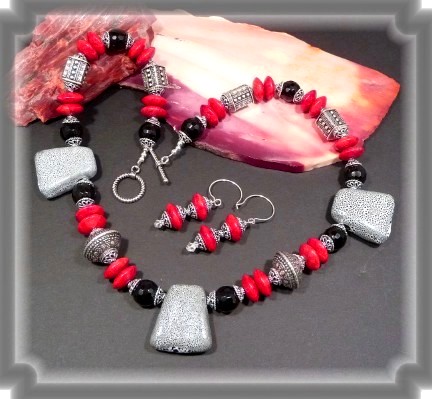
This design incorporates four very different textures: ceramic, cut coral, polished gemstones and metalic silver plate. Grey Ceramic Axe-shapped Beads are the focal point of the necklace, highlighted by Red Sponge Coral rondels, faceted Black Agate (onyx) beads and silver plated acent pieces with silver toggle clasp.
.
The necklace is complemented with a pair of French Hook silver earrings containing matching Red Sponge Coral rondels and Silver highlight bead caps.
.
The necklace is 18 inches long.
.
This piece and others will be available at the upcoming Fall Jewelry and Craft Shows in the San Antonio area.
.
.

Monday, July 19, 2010

OPAL - Australia's National Gemstone

Based on several requests have decided to do a Blog on Opals. However this specific BLOG deals with Australian Opals. Many thanks must go to the Jewelers Association of Australia for their information and pictures. There are other major varieties of opals not covered here, Mexican Fire Opals (transparent to translucent opals with warm body colors yellow, orange, orange-yellow or red and they do not show any play-of-color), Peruvian Opals (semi-opaque to opaque blue-green, green, blue or pink stone found in Peru which is often cut to include the matrix in the more opaque stones. They do not display pleochroism), to name a couple. Other varieties of opal can also be found in Slovakia, Brazil, Ethiopia and the Northwest and Southwestern United States with new finds now reported in China.
The Australian Opal. Nature has captured all the colors of the spectrum, displaying them in an infinite variety of shades, patterns, and brilliance and locked them into this rare stone. Opals lie dormant in the earth until a miner clips the edge and light reaches the gem exposing the most beautiful dancing displays of color. This ‘Play of Color’ is the basis for the opals beauty. It is unique in the world of gemstones. It originates from the breaking up of white light due to the three dimensional spherical shaped microstructure of the silica partials inherent in the opal. Similar color phenomena can be observed when oil lies on water. Opals occur where silica gel fills small fissures or voids in the earth. A large portion of Australia’s inland was once covered by a sea, leaving deposits and creating an environment suitable for the formation of the opal. As the cellulose of the tree wood decays, it leaves empty cells in the wood. As the silicon rich water seeps down into the void, it eventually dries out and leaves the silicon behind to form opals. Some of the water is retained by he silicon dioxide...which is why opals contain so much water. The silicon forms as small rows of round spheres that create the ‘Play-of-color’. Natural Opals are divided into categories to distinguish the location where mined and the specific variety of Opal.


BLACK OPAL is the most valuable and comes mainly from Lightning Ridge. High quality stones are very rare; this type is easily distinguished by the blackness of the base or background body tone.


BLACK CRYSTAL OPAL is mainly mined at Lightning Ridge. These black opals show a degree of transparency, the colors are often brilliant and can appear to come from within the depth of the gemstone. Good black crystal opals are extremely rare.


DARK OPAL comes from all the fields and is desirable because the colors are generally more brilliant, due to the dark background highlighting the colors. Good specimens of this type of opal mainly come from Mintabie and Lightning Ridge.


LIGHT OPAL is usually found at all opal fields but the bulk of the better material comes from the South Australian fields of Coober Pedie and Andamooka, although the first material was mined at White Cliffs. Some light opals are so light they are called White Opals (2nd picture above).


CRYSTAL OPAL embraces opals which are transparent or very translucent and in the better quality stones shows a distinct and very bright play-of-color. This type of opal is found in most Australian opal fields.


BOULDER OPAL is composed of opal naturally occurring on its host rock. It is mined predominantly in Queensland. It is easily identified because when cut, the host rock if left on the sides and/or back of the opal. Boulder Opal may be light, dark or black within the host rock. This type of opal in cabochon settings, has become very popular in the past few years, especially those stone that have the host rock all around the ‘window’ of opal in the center of the stone.


MATRIX OPAL comes in two types in Australia.


-BOULDER MATRIX OPAL is usually found in Queensland. The opal is intimately diffused with the host rock (usually ironstone so is magnetic), which is quite obvious in the presentation face of the stone.

-MATRIX OPAL from the Andamooka area has opal internally diffused throughout the host rock, a sandstone, which is often porous and can be treated, turning the material dark, resembling black opals.


NATURAL OPALS are the complete opal cut and polished as one piece. These can be very fragile and easily damaged when worn.


COMPOSITE NATURAL OPALS consist of a natural opal laminate manually cemented or attached to another material. There are three main types.


-DOUBLET OPAL is a composite of two pieces where a slice of natural opal is cemented to a base backing material.


-TRIPLET OPAL is a composition of three pieces where a thin slice of natural opal is cemented between a dark base material and a transparent top layer, usually of quartz or glass.


-MOSAIC CHIP OPAL is a composition of small flat or irregularly shaped pieces of natural opal cemented as a mosaic tile on a dark base material or encompassed into resin.

.

There are three (3) specific other Opal types that also come from Australia that I hope to gather further information on and be able to post a Blog in teh near future on them - Andamooka, Koroit and Yowah Opals. Check out the Opal Forum at

http://forums.opalauctions.com/viewtopic.php?f=3&t=1647&start=180

for informatin on these Opals.

SYNTHETIC and IMITATION OPAL has become a real problem worldwide, but not a problem in Australia. Australian law deals harshly with anyone making or selling synthetic or imitation opals and the few retailers who have them, will have them so marked and inform purchasers of this fact. You will see very few within Australia.

For our budding gemologist and geologist, opal is a mineraloid, it is an amorphous SIO2 - NH2O (hydrated silicon dioxide). The water content is usually between three and ten percent, but can be as high as 20%. It is a 6 on the Mohs scale of hardness. Opal has a RI: 1.44 - 1.46 -- Birefringence: None -- Optic Character: None -- Specific Gravity: 2.10 average but varies based on amount of water contained in the stone.

Opal is the traditional birthstone for October and the state gemstone of Nevada.

Caring for your Opals
As with Pearls, the number one care item for Opals is to never have them on when using hair spray or wear them when doing rough work.
Solid Opals -- Opal is a soft stone, so it is important to treat your opal carefully In order to avoid damaging it. Remove your opal jewelry if there is a chance it will be scratched or broken (i.e. working in the garden, moving furniture, etc.) Many people believe solid opals can be damaged by water - however, this only applies to doublets and triplets. Solid opals are fine in water. In fact, most precious opals contain about 5-6% water. As a result, opal may crack if subjected to very dry conditions or rapid changes in temperature. Try to avoid very high temperatures or low humidity extremes, such as boiling water or zero humidity bank vaults.
Doublets & Triplets -- Caring for doublets or triplets is a little different to caring for opals. Because doublets and triplets consist of multiple layers glued together, prolonged exposure to water will eventually cause lifting between the layers and the infiltration of water. A doublet or triplet will take on a 'foggy' or grey appearance if this happens. This does not mean your opal will be ruined if you wear it in the shower once, or are caught in the rain. It takes prolonged exposure to cause water damage to a doublet or triplet.
Cleaning Your Opals
Solid opal should be cleaned gently with mild detergent in warm water and a soft toothbrush or cloth. Avoid bleach, chemicals and cleaners. Doublets & triplets may be wiped with a damp soft cloth and mild detergent, but should never be soaked or immersed. Never allow anyone to clean your opal in an ultrasonic cleaner, as the intense vibrations may cause cracking in a solid opal, and water penetration in a doublet or triplet. If your stone loses its shine or becomes scratched, bring it back to an opal cutter. After years of wear, small scratches and scuff marks cause an opal to lose its shiny polish and become dull looking. Professional polishing can bring new life to an opal which has become dull or scratched, and we can also check for claw damage and ensure the security of the setting.
Storing Your Opals
If you need to store your opal away for a period of time, simply place it in a padded cloth bag for protection and store it away. For longer storage periods, place your opal in a sealed plastic bag wrapped in cotton wool with a few drops of water just to be safe. The water is not intended to soak into the stone (as opal is impervious) but will prevent water coming out of the stone if it is exposed to very low humidity environments (for example, zero humidity storage safes).

.