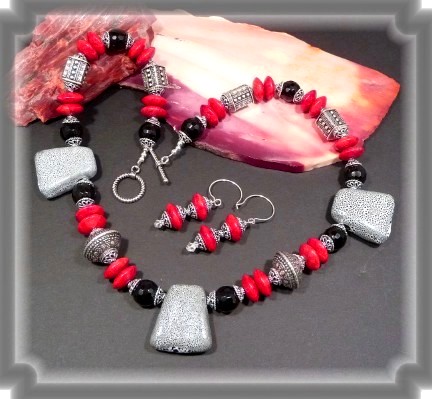
Brighten up your Holiday wear with one of these Holiday Jewelry Sets designed by Gayle.


Your can see these and more at
COKERFEST
Saturday November 5th
9AM to 4PM
Coker UMC, North Loop Rd, San Antonio


You are looking at true Southwest. The colors of the desert - tans and browns - are predominent in the Sterling Silver bezel set Wild Horse Magnesite triangular pendant. Magnesite barrels and Ivoryite rondels are interlaced with sterling silver and chain links to give this 19 inch necklace with 2 inch extender its fantastic look. Magnesite and Ivoryite are further paired in teh 1 inch long Leverback earrings that complete the set.

Magnesite occurs as veins in and an alteration product of ultramafic rocks like serpentinite, turquoise and other magnesium rich rock types in both contact and regional metamorphic terranes. These Magnesites often are cryptocrystalline and contain silica as opal or chert. Magnesite is also present within the regolith above ultramafic rocks as a secondary carbonate within soil and subsoil, where it is deposited as a consequence of dissolution of magnesium-bearing minerals by carbon dioxide within groundwaters. Some of the best Magnesite deposits that can produce gemstone quality material are co-located with Turquoise deposits in the southwestern United States.


Ivoryite is a great substitute for ivory. It is a sedimentary precipitate of magnesium, calcium and silica. It is 5 to 5-1/2 on the Moh's scale, which makes it slightly harder than ivory. Ivoryite can be worked with metal tools, but cuts effortlessly with diamond tools. Polishes well with diamond, tin oxide, cerium oxide or white rouge. Excellent material for inlay, cabochons and small carvings. Do not confuse Ivoryite with Ivorite, whic is a black tektite material from Africa. The majority of Ivoryite currenly comes from the western United States, especially Colorado and California.


As one visits the Caribbean, the vibrant colors that are seen in the Ocean, on the Islands and in the Sunsets inspired this jewelry collection called "Caribbean Delights". The first two sets covered the green of the islands and the blues of the water, we now look at a Caribbean Sunset.


The Caribbean Sunset is reflected in this necklace with a rust-blue-gold Sonoran hand blown leaf at the center. Carnelian barrel beads and chips are then complimentd by crystals and cat-eye beads in sunset colors of reds, dark and light pinks, blues and copper. The necklace is 20 inches with a 2 inch extender and a Lobster Claw Clasp. The French Hook Earrings hang 1 1/2 inches.
 Sonoran Leaves are a specially fired glass that is made into the shape of leaves in different sizes for use in pendants and earrings. Boro glass is a particular type of glass, better known under the brand name of Pyrex. It was first developed in the late 19th century and was used primarily for scientific glass due to its strength and durability. Artists have started to use boro glass for bead making even though it is a very hard glass and requires high heat to form a bead. Boro glass has a very distinctive range of colors from varions other minerals or impurities, often much more vibrant than the softer European glass. Sonoran Leaf pieces are made one at a time, in a flame. Because they are made by hand there may be slight variations in color from one batch to another. Do not confuse these Sonoran Leaves with other types of poured or fused glass leave made in bulk.
Cat-eye beads and colored crystals were also used in this set.

A second set of earrings using Sonoran Leaf dangles to match the center highlight of the necklace is also available.


Cloisonné is an ancient technique for decorating metalework objects, but in recent centuries using vitreous enamels, and also inlays of cut gemstones, glass, and even linen. and other cloth materials, has become common place, especially in jewelry beads.
Czech Glass Crystals or perhaps better known as Bohemian glass, or Bohemia crystal, is a decorative glass produced in regions of Bohemia and Silesia, now in the current state of the Czech Republic, since the 13th century. Oldest archaeology excavations of glass-making sites date to around 1250 and are located in the Lusatian Mountains of Northern Bohemia. Both Novy Bor and Kamenicky Senov have their own Glass Museums with many items dating since around 1600. These locations were especially outstanding in its manufacture of glass in high Baroque style from 1685 to 1750. In the 17th century, gem cutters in Prague, adapted to glass the technique of gem engraving with copper and bronze wheels. In the second half of the 19th century, Bohemia looked to the export trade and mass-produced colored glass for shipment all over the world. Today the Bohemian Glassworks Company is the producer of fine Czech crystals, Bohemian glass and Swarovski crystals. The latest project has been the firing of glass nail files.
Lapis Lazuli is a rock, not a mineral: whereas a mineral has only one constituent, Lapis Lazuli is formed from more than one mineral. The main component of lapis lazuli is Lazurite, and a feldspathoid silicate mineral. Most Lapis Lazuli also contains Calcite (white), Sodalite (blue), and Pyrite (metallic yellow). There can also be other possible constituents and trace amounts of other minerals. Lapis lazuli usually occurs in crystalline marble as a result of contact metamorphism. The finest color is intense blue, lightly dusted with small flecks of golden Pyrite. Stones with no white Calcite veins and only small Pyrite inclusions are more prized. Patches of Pyrite are an important help in identifying the stone as genuine and do not detract from its value. Often, inferior Lapis is dyed to improve its color, producing a very dark blue color with a noticeable grey cast which may also appear as a milky shade. Lapis takes an excellent polish and can be made into jewelry, carvings, boxes, mosaics, ornaments, and vases.
Cord beads and glass Peafrls are also used in this set.

The light blues and aquas of the Caribbean Sea are highlighted in the necklace with a large aqua Sonoran Leaf as the focal piece. Czech glass nuggets with an aqua thread complement the crystals and seed beads with silver accents along the sides. A silver plated Lobster Clasp with a 2 inch extender on this 18 inch necklace gives the wearer an option on length. Matching crystal French Hook earrings complete the set.
Sonoran Leaves are a specially fired glass that is made into the shape of leaves in different sizes for use in pendants and earrings. Boro glass is a particular type of glass, better known under the brand name of Pyrex. It was first developed in the late 19th century and was used primarily for scientific glass due to its strength and durability. Artists have started to use boro glass for bead making even though it is a very hard glass and requires high heat to form a bead. Boro glass has a very distinctive range of colors from varions other minerals or impurities, often much more vibrant than the softer European glass. Sonoran Leaf pieces are made one at a time, in a flame. Because they are made by hand there may be slight variations in color from one batch to another. Do not confuse these Sonoran Leaves with other types of poured or fused glass leave made in bulk.
Czech Glass Crystals or perhaps better known as Bohemian glass, or Bohemia crystal, is a decorative glass produced in regions of Bohemia and Silesia, now in the current state of the Czech Republic, since the 13th century. Oldest archaeology excavations of glass-making sites date to around 1250 and are located in the Lusatian Mountains of Northern Bohemia. Both Novy Bor and Kamenicky Senov have their own Glass Museums with many items dating since around 1600. These locations were especially outstanding in its manufacture of glass in high Baroque style from 1685 to 1750. In the 17th century, gem cutters in Prague, adapted to glass the technique of gem engraving with copper and bronze wheels. In the second half of the 19th century, Bohemia looked to the export trade and mass-produced colored glass for shipment all over the world. Today the Bohemian Glassworks Company is the producer of fine Czech crystals, Bohemian glass and Swarovski crystals. The latest project has been the firing of glass nail files.
Crystals and seed beads are also used in this set.

Millifiori is a glasswork technique which produces distinctive decorative patterns on glassware. The term millefiori is a combination of the Italian words "mille" (thousand) and "fiori" (flowers). Apsey Pellatt was the first to use the term "millefiori", which appeared in the Oxford Dictionary in 1849. This type of bead was called mosaic beads before then. While the use of this technique long precedes the term millefiori, it is now frequently associated with Venetian glassware. More recently, the millefiori technique has been applied to polymer clays and other materials. Because polymer clay is quite pliable and does not need to be heated and reheated to fuse it, it is much easier to produce millefiori patterns than with glass.
Shell and Crystals are also used in this set.


SOLD As blue a the waters of the Caribbean, a blue colored 2 inch Sonoran Glass Leaf is the focal point of this 20 inch necklace. Opalite and Lapis beads along with crystals have been charmed to highlight the leaf. Wavy Lapis beads and chips, bronze accents and a bronze Toggle clasp complete the necklace. Clusters of charmed beads and crystals hang from the Frech Hook earrings to complete the set.
.
Lapis Lazuli is a rock, not a mineral: whereas a mineral has only one constituent, Lapis Lazuli is formed from more than one mineral. The main component of lapis lazuli is Lazurite, and a feldspathoid silicate mineral. Most Lapis Lazuli also contains Calcite (white), Sodalite (blue), and Pyrite (metallic yellow). There can also be other possible constituents and trace amounts of other minerals. Lapis lazuli usually occurs in crystalline marble as a result of contact metamorphism. The finest color is intense blue, lightly dusted with small flecks of golden Pyrite. Stones with no white Calcite veins and only small Pyrite inclusions are more prized. Patches of Pyrite are an important help in identifying the stone as genuine and do not detract from its value. Often, inferior Lapis is dyed to improve its color, producing a very dark blue color with a noticeable grey cast which may also appear as a milky shade. Lapis takes an excellent polish and can be made into jewelry, carvings, boxes, mosaics, ornaments, and vases.
Opalite is a stone mined in Utah that comes in varying shades of purple, lavender and creamy white with swirls of yellowish-brown and pink. Opalite is also referred to as Tiffany Stone. Opalite is also a trade name for synthetic opalized glass and various opal simulants. The name is also many times used to promote impure varieties of variously colored common opals.
.
 A Summer day can end with a beautiful red sunset and at the same time have the white of lights and stars combine in a burst of color.

 SOLD
SOLD

 Turquoise is an opaque, blue-to-green mineral that is a hydrous phosphate of copper and aluminium. It is rare and valuable in its finer grades and has been prized as a gemstone and ornamental stone for thousands of years owing to its unique hue. In recent times Turquoise, like most other opaque gems, has been devalued by the introduction of treatments, imitations, and synthetics onto the gemstone marketplace. The substance has been known by many names, but the word Turquoise was derived around the 16th century from the French language 'turquie', for a Central Asian material which was a very early imported through Turkey from Persia. Today, Persian and certain southwestern United States Turquoise, especially Sleeping Beauty, commend some of the highest prices paid for this gemstone.
.jpg)
.jpg) Red Sponge Coral rondels and Silver highlight bead caps.
Red Sponge Coral rondels and Silver highlight bead caps.

 mon mineral. It is one of the most common minerals on the face of the Earth, comprising about 4% by weight of the Earth's crust and is formed in many different geological environments. Calcite can form rocks of considerable mass and constitutes a significant part of all three major rock classification types. Some of these rock types are composed of better than 99% calcite. Why would a collector be interested in such a common mineral? Because of its extraordinary diversity and beauty! The jewelry industry has become facinated with its beauty and many colors.


 The Japanese freshwater pearl industry holds a special historic value as the first country to cultivate whole freshwater pearls in Lake Biwa. The industry attempted a comeback with a mussel hybrid in Lake Kasumigaura in the last decade, but this venture also met with failure, with all production ceasing in 2006. A pearl farm in Tennessee also holds special historic value as it is the only place freshwater pearls have been developed outside of Asia. Freshwater Pearsl come in a variety of shapes and colors, and dependant on the seed placed into the mussel.
 As previously discussed, many times using different textures can create interesting designs. In the same way different materials can also be used to give depth or balance to a design or highligh specific colors or parts of a highlighted piece in the design.
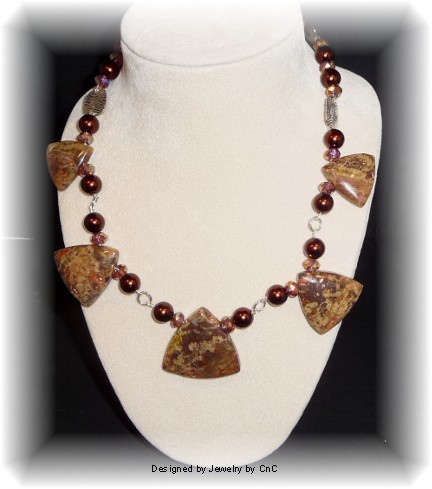 Now then what are AB crystals ? Aurora Borealis, usually abbreviated AB for short, is a name that has been given to faceted glass crystal beads that have an added iridescent coating placed on the outside of the facets. This coating produces a multi-color reflection which changes color as the beads are rotated. One must be careful when cleaning AB crystal beads, as sometimes in the lower cost varities, this coating can be scratched or come off. AB coating is also used on larger glass pieces to give them the iridescent reflective property also.
 Mother of pearl is the common name for iridescent nacre, a blend of minerals that are secreted by oysters and other mollusks and deposited inside their shells, coating and protecting their bodies from parasites and foreign objects. Although pearls are popular today, some past cultures regarded colorful pieces of mother of pearl as more desirable decoration for jewelry and other objects. Jewelry made from mother of pearl is in the group called organic jewelry, which includes all jewelry that originates from a living creature, plant or other living organism. Mother of Pearl has made a big comeback in jewelry in the past few years, and is today rated almost equally with many forms of pearls.
 Two substances actually combine to create mother of pearl. The first is plates of aragonite, a material which is secreted by the mollusk. Aragonite contains calcium carbonate and conchiolin, a natural protein. Alone, the plates are very hard, but also very brittle. As a result, the organism also secretes organic material similar to silk to layer between the plates. The result is a strong, flexible material which can withstand hard use.