Pages

Showing posts with label gemologist. Show all posts

Tuesday, October 4, 2011

Agatized Fossil Corals !


Fossil Coral is a natural stone primarily found in Indonesian water that is formed when ancient Coral is gradually replaced with Agate. The proper name for this material is "agatized coral" or "agatized fossil coral". The fossilized coral typically appears as small flower-like patterns in the stone.


Agatized fossil coral can exhibit a wide range of natural colors, ranging from white and pink to brown, gray, black, yellow and red. Corals may vary widely within a single stone depending on weathering and oxidation and the original mineral content.


Corals are among the most colorful animals in the sea. Most corals live in warm, shallow, tropical seas and feed on plankton. The oldest fossil corals are from the Ordovican period, over 450 million years ago. Corals are marine animals with a sac-like body, mouth, tentacles and skeleton. It is the skeleton that survives in the fossil record. Corals may be solitary or found in large colonies.


These corals were buried in sediment as the land surface was affected by crustal plate movements or the oceans rose and fell. Temperature and pressure from compaction during burial resulted in those deposits becoming rock and part of the present day geological record.

Under unique geological conditions, prehistoric corals and mollusks can fossilize by being replaced with agate from silica-rich ground water percolating through limestone. Of the varieties of fossilized corals found throughout the world exquisitely detailed specimens from the mountains of Indonesia are among the most unique. In Indonesia, entire coral heads are often completely preserved and appear just as they did 20 million years ago, although their density is much changed by replacement with silica, iron, manganese and other minerals. There are fern corals, brain corals, hex corals, honeycomb corals and many more.


Florida and Georgia in the USA are also import sources of fossil coral. In fact Florida has declared fossil coral to be the Florida State Rock.


Fossil coral pieces are sought by gemstone and fossil collectors around the world. as well as being used in beads and other jewelry. Since agate is fairly hard and very durable, fossil coral is suitable for all kinds of jewelry.

Tuesday, September 20, 2011

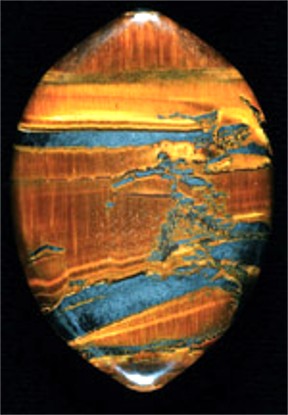
Tiger's Eye, Tiger Iron or Hawk's Eye - you select your choice !

If these three gemstones were placed in front of you, could you pick them out immediately? I hope so by the time you finish reading this Blog.

Tiger’s Eye is a chatoyant gemstone that belongs to the Quartz family. It is normally a metamorphic rock which is yellow to red-brown in color with a silky luster. Chatoyancy is a changing in the luster or color of a gemstone as light is reflected within the thin parallel fibrous bands. The fibrous structure of the material is what causes this effect to happen. Tiger's Eye gemstones are normally cut into various cabochon shapes to best display their chatoyancy. Tiger's Eye can also show a Cat's Eye effect.

Tiger's eye is derived from Crocidolite (a mineral comprised of iron and sodium) which has been oxidized to a golden brown from its original blue color and the Crocidolite has been totally replaced by Quartz. An incomplete silicified process producing a blue variant is known as Hawk’s eye.

Even though the iron and sodium dissolves when the Quartz becomes imbedded between the fibers of Crocidolite, there are traces of hydrated oxide of iron that are left between the Quartz and Crocidolite, thus creating the golden color that is common to the Tiger's Eye gemstone. How golden brown, red, blue or green the Tiger's Eye and Hawk's Eye ends up is determined by how much of these varying amounts of hydrated minerals are deposited. The rarer blue Hawk's Eye will have only the slightest amounts. Tiger's Eye is also called a Cat’s Eye Quartz when the color is greenish grey. It is called Tiger’s Eye Cat Eye when the brown stone reflects a golden yellow stripe and if the stone is bluish or blue gray, then it is known as Hawk's Eye Cat Eye. The rare mahogany or any redish colored stones are known as Ox Eye or Bull's Eye.

Tiger's Eye is also a pseudomorph. Pseudomorphs form when one mineral replaces another. Since Tiger's Eye is a Quartz replacement of Crocidolite, therefore it is a pseudomorph of Quartz after Crocidolite. The same thing happen when Quartz replaces wood to produce Petrified Wood. Tiger's Eye is also considered as one of the most popular chatoyant gemstones.

Now we throw in a confusion factor for identification. Tiger Iron is a composite gemstone of black Hematite, red Jasper and Tiger's Eye. It has rippled wavy bands of color often which resemble a scenic view. It usually has a greenish cast with shades of golden yellow, brown and reds. Marra Mamba is a form of Tiger Iron that was found only in a specific area of Australia near Mount Brockman. It is a very rare type of Tiger Iron that contains shades of green, red, blue and yellow. Since the area has been mined out for many years, very little of the "true" Marra Mamba is available in todays markets. If you want to see some, find a good collector or a museum that might have some.

Tiger’s Eye is often heat treated in which any changes are permanent, therefore no extra care is needed, but just like any other gemstone it should be protected from sharp blows, heavy scratches and large temperature changes. Quartz dust can be hazardous to breathe according to several recent research studies. Since the fibrous mineral in most Tiger's Eye has been completely replaced by Quartz, it is best to take adequate precautions to avoid breathing any of the dust when cutting or polishing Tiger's Eye, or any oher Quartz stone.

The fibers in Tiger's Eye are very thin and may only be an inch or two long. Most are only 0.001 millimeters, in diameter. Since Tiger’s Eye normally has bend or twisted fibers, sawing can be tricky and cuts must exactly parallel to the length of the fibers in order to get the full chatoyant effect. You will end up with a lifeless, dark brown to black worthless stone if the saw cut is perpendicular to the fibers. Very careful cutting and polishing is required to line all the fibers up to get a true cat-eye effect.

Red Tiger's Eye is not a natural occurrence in most cases. It is usually a result of deliberate heating. Honey-colored Tiger's Eye have been used to imitate much higher valued Cat’s Eye Chrysoberyl. The most common man made imitation of Tiger's Eye is an artificial fiberoptic glass and/or resin that is produced in a wide range of unusual colors.

Tiger’s Eye commonly comes from South Africa but also can be found in Burma, Australia, the United States and India.

Monday, May 10, 2010

GEMSTONES - Identification !

Learn what these pictures are about and the meaning of them at the
.
Southwest Gem and Mineral Society Monthly Meeting
.
Tuesday - May 11th
.
General meetings are held the second Tuesday of each month with the exception of October (our annual picnic) and December ( our Christmas party). Doors open at 6:00 PM for refreshments and socializing. General meeting starts at 7:00 PM. Currently the group meets at the Celebration Bible Church at US-281 and Dondella Dr. Check the SWGMS web-site for announcements pertaining to a change in location over the next few months. The June 8th meeting will be at the Geology Department at UTSA.
.
.
A change in plans has been made for the May 11th meeting. Thanks to a friend of Jewelry by CnC, a collection of faceted gemstones has been made available and will be shown at the Southwest Gem and Mineral Society meeting. In addition there will be a presentation on the Types of Gemstones, an overview on the Identification of Gemstones and the equipment used in the identification process.
.
.
We hope all members of the SWGMS and prospective members as well as guests can attend and we will be looking forward to presenting the information and showing the borrowed collection of over 300 faceted gemstones.
.
.
See you there !
.
.

Saturday, May 8, 2010

GREEN GEMSTONES -- Marketing !

Here we go again ! With the popularity of the color Green for Spring and into early Summer, there are several green gemstones available for the jewelry wearer. You can find green in faceted gemstones, cabochon cuts, pendants and tumbled stones as well as crystals. The names of most of the green gemstones are familiar to most people - Emerald, Chrome Diopside, Sapphire, Spinel, Tourmaline, Diamond, Amazonite, Moss Agate, Kambaba Jasper - to name a few of the more popular. And there are a few color change stones that also can appear in greens - i.e. Alexandrite. But of course a green Diamond, a good Columbian Emerald or an Alexandrite will cost one a pile of money.
.
So what do the miners, vendors and dealers do, use "marketing" techniques that draw the most attention from the public. Certain gemstones over the years are well known to most people, and the associated name makes them very popular and people know what they are looking for when they hear the names. Amethyst and Morganite are two examples. Amethyst, a purple member of the Quartz family, has colors that run from a very light lilac to a strong deep purple. Morganite, a pink member of the Beryl family, can be pink and range to a peach color. So over the years, when a person hears the name Amethyst, they immediately think of the February birthstone and the color purple. Likewise with Morganite, it is not only people that change their name, but gemstones sometimes do also. And so it was that in 1911, on the suggestion of the New York gemologist G. F. Kunz, for whom the purple gemstone Kunzite was named, that the pink variety of Beryl was ennobled to the status of a gemstone in its own right in honor of the banker and mineral collector John Pierpont Morgan and was given the name under which it is known today: Morganite.
.

Green Amethyst (Prassolite)

.
So with this history and naming in mind, dull named light green Beryl and green Prassolite got a "marketing" boost. Prassolite was marketed by the Jewelry TV stations and many dealers and eBay sellers as "Green Amethyst" and the latest marketing run is the naming by the same groups of the light green Beryl, calling it "Green Morganite". By doing this not only do the two gemstones get more notority, but the price per caret also jumps dramatically. This falls in line with the old known stone called 'Turkish Diaspore' now going under the catchy name of 'Zultanite", and costing the buyer more per caret for the material.
.

Green Morganite (green Beryl)

.
As with many things, marketing is the answer to an item selling or not selling, so "what is in a name ?" Nothing wrong with naming an item whatever you want if it sells better under the 'marketing' name, but the seller should also be aware and remind the buying public what the official agreeded upon gemological name of the gemstone actually is.
.
.