Saturday, December 12, 2009

Face Shapes and Jewelry Styles

With gift giving in vogue for the Holidays, one thing to remember is that various styles of Necklaces and Earrings most of the time go best with particular face shapes. Here are some some suggestions by the "experts", but in the end, remember it all depends on what one likes and what the person you are giving the gift to wants to wear and what they feel looks best. What "you" like and looks best on you, is not always the best shape and style for the one to whom you are giving the jewelry gift to.
.
OVAL FACE = Necklaces - wear anything from a choker to a “V” necklace, to a long strand of beads. With this face you can pull anything off. Earrings - Once again, you can pull from any look, so don’t be afraid to wear anything you like.
.
ROUND/SQUARE FACE = Necklaces - Your goal is to slim down the face, use long necklaces, stay away from Chokers and large round beads. Earrings - Anything long that draws attention down instead of around is very flattering.
.
RECTANGLE FACE = Necklaces - Opposite of the round face, a rectangular face needs to have width added. Something short with thick beads. Earrings - A button or post style looks best, to shorten the length of the face.
.
HEART FACE = Necklaces - many say chokers look best because it softens the sharp angle of the chin, and if you add double or triple layers is adds width around the neck balancing the thinness and angles of the chin. Earrings - teardrops, long upside down triangles, something to draw attention away from the narrowness of the chin.
.
And as originally said, in the end, no matter what is suggested by the "experts", what is worn is one's own decission to make. Just remember some shapes and colors go much better with your figure, clothing and other accessories. It all depends on how you want to stand out -- classy or exotic.
.

Thursday, December 10, 2009

Tanzanite - Three Kinds !

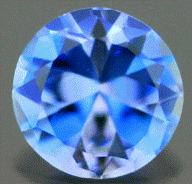
True Blues: While in Tanzania last summer, gemologist Chris Smith, discovered that many Tanzanites come from nature already blued. Because every Tanzanite that is mined is sent for heating, it is assumed by almost everyone that all of these Zoisites need oven time to be baked to this gem’s distinctive violet-blue coloration. But during a visit last fall to Tanzanite One, the De Beers-like mining and marketing organization for most of the world’s tanzanite, gemologist Chris Smith, found that a significant number of mine-run Zoisites had already been blued in the ground. “I was quite surprised to see that quite a number of stones were coming from the ground with a natural blue color," said Chris. So Chris started a project to determine a means of identifying natural-color tanzanite. As part of the study, he found there were three kinds of stones being mined.
.
Natural Brown Tanzanite: The first and by far the most predominant are those with the root-beer bottle brown that need heating to be converted to blue; Natural Blue Tanzanite: the second have been partially naturally annealed by heat or lightning, so display an overall blue appearance but show brown in one direction; Annealed Blue Tanzanite: the third are stones that have been fully annealed and no longer possess any brown coloration.
.
Does this mean that there could be what Smith calls “a new niche market” for natural-color, as opposed to heated Tanzanite—similar to that for sapphire? Smith believes so, but is quick to say that the applications of his findings are better left to marketers rather than gemologists. And lately since Tanzanite is actually a Zoisite relative, green colored "Tanzanian" stones are starting to appear on the market.
.
Thanks to Chris and Colored Stone Magazine for the updated pictures.
.
.

Tuesday, December 8, 2009

Gem Fair Tucson 2010 !

Some additional Pavillions that have been added to the AGTA GemFair Tucson for 2010.
.
MJSA EXPO West:
The Manufacturing Jewelers and Suppliers of America (MJSA) brings back the MUSA EXPO Pavilion to the Gem Fair this year. It is your destination in Tucson for tools, equipment, technology, packaging, services and supplies. MUJA will also hold bench jewelry demonstrations every day as part of their 'At the Bench Live' series.
.
COLORED DIAMONDS PAVILION:
As colored diamonds continue to rise in popularity, the AGTA has established a special pavilion to feature AGTA colored diamond dealers. This pavilion will be located in aisle 1600 on the GemHall floor. This pavilion will offer attendees a great selection of loose gemstones and finished settings.
.
Go to the following URL to see a listing of all exhibitors for the AGTA Show only:
.
.

Wednesday, December 2, 2009

16th Annual San Antonio Christmas Extravaganza !

New Items for the Christmas Show on Dec 5th and 6th at the Live Oak Civic Center on Pat Booker Rd just off 1-35 and Loop-1604, 10am to 5pm both Saturday and Sunday.
.
Pietersite Shield Pendant mounted on a faceted Oregon Sunstone, Pietersite and Crystal necklace with Silver clasp and matching French Hook earring set.
.
.
.
.
.
Chilean Phosphosisite and Silver on a Ribbon neck-cord with matching French Hook earrings.
.
.
.
.
.
.
Onyx and Carnelian with Silver Highlights and clasp with matching French Hook earrings.
.
.
.
.
.
.
We hope to see our San Antonio area friends and customers at Live Oak. This will be our last show for 2009. Hope you can make it to see these and other new pieces just constructed.
.
.

Tuesday, December 1, 2009

Changes in the Pearl Industry !

If you've always been in love with pearls but not so much in love with the price tag on a typical strand of perfect pink-and-cream akoyas, you're in luck. The pearl has been through a major transition over the past decade; Chinese producers have begun culturing and marketing a whole new segment of freshwater pearls that are beautiful, colorful and best of all, affordable. Freshwaters, as their name suggests, are grown in freshwater lakes as opposed to saltwater, where traditional akoyas are cultured, mainly in Japanese waters. This change in pearl farming has meant profound differences in the variety of pearls available on the market. Chinese freshwaters offer greater choice, higher quality and lower prices.
.
.
Once considered a white gem, like diamonds, the cultured pearl is now being positioned by many dealers as a colored stone, with almost as many hues as sapphire or tourmaline. Mauve, brown or orange pearls from China now seem more common than the classic white akoya pearls from Japan. The vast majority - probably 95% - of pearls produced today come from the fresh waters of China, most of which are natural white, peach and lilac. Many farmers expand the range of color by dyeing freshwater pearls, but if they are white, mauve or peach, the color is usually natural. Plenty of white pearls now come from China, too, and they're grown in freshwater lakes, not saltwater bays, using mussels rather than oysters, where traditional akoya pearls come from.
.
The emergence of China as the world's leading pearl producer has brought unprecedented pearl diversity. Ask your jewelry retailer about Chinese freshwater pearls. the next time you are in the market for that string of "white lovelies".
.
Partial reprint from Firstnews England.
.
.

Monday, November 30, 2009

16th Annual San Antonio Christmas Extravaganza !

We have added one more show for the 2009 year. Jewelry by CnC and Timeless Designs will be at the upcomg 16th Annual San Antonio Christmas Extravaganza. New and currents designs will be available for purchase via the websites after this show is over!! Mark your calendars for next weekend and come on down to the Live Oak Civic Center for some last minute shopping!! December 5th – 6th, Saturday & Sunday: 10:00am – 5:00pm (both days)
.
Jewelry by CnC will have-
--Stock of unmounted pendants, wide selection of cuts to choose from
--New jewelry set designs, including some for men
--Select lapidary slabs and a small selection of faceted gemstones, cabochons, both mounted and unmounted.
.
Timeless Designs will have-
--A few glass pendant & earrings sets
--Several new fossil and natural stone single pendants and a few with earrings
--A selection of wired custom jewelry in some of nature’s beauties….Stones, Ocos Agates and Fossils
.
So grab your list, mark your calendar and come join us for that last minute shopping, giving gifts of nature handcrafted and customized for every individual. Check our BLOGs for last minute announcements --- Jewelry by CnC --- Timeless Designs
.
.

Sunday, November 29, 2009

Lapidary and Gemstones - unusual finds !

MAW Sit Sit --- A beautiful green colored stone that looks like fine quality jade, which makes sense since one of the constituents that make up Maw Sit Sit is jadeite. It is a metamorphic rock that was formed when higher pressure changed a formation of igneous rocks. The formation had a lot of chromium based minerals such as chromite and chrome rich jadeite, which accounts for the color. Maw Sit Sit has been pretty rare on the market, but more and more of it is appearing as time goes by. This is a wonderful example of what the gemstone world can offer with an unusual name from a small place that no one has heard of ... until they named a gemstone after it, from a place called Maw Sit Sit in upper Myanmar. Maw sit sit was first identified by the late Dr. Eduard Gubelin in 1963 and named after the village close to the site where it was found. It is currently on the list for non-importation into the USA along with Myanmar (Burma) Rubies unless one can show a purchase date before the law went into effect.
.
.
Zoisite Conglomeriate --- This beautiful combination of Ruby embedded in a matrix of green and black Zoisite is also known as Anyolite. This stone has wonderful red Ruby crystal structure embedded in a natural matrix of green and black Zoisite. It is strikingly dramatic, beautiful and hard to come by. Bright and bold opposite colors contrast to form exquisite patterns people love to look at. Although Anyolite is many times advertised as a variety of Zoisite from Kenya and Tanzania, Anyolite is actually a metamorphic rock composed of intergrown green Zoisite crystals, black Tschermakite cystals, and Ruby crystals. It is said to be named after the Maasai word 'anyoli', meaning "green." The contrasting colours make Anyolite a popular material for sculptures and other decorative objects. It was first discovered at the Mundarara Mine, near Longido, Tanzania in 1954. Much of the material now being called Zoisite Conglomeriate nows comes out of South Africa. Anyolite is also referred to as Ruby in Zoisite or Tanganyika Artstone when smaller amounts of the black Tschermakite crystals are present. Do NOT confuse Ruby if Zoisite with Fushite, especially when it is Ruby in Fushite).
.

Septarian Concretion --- Concretions are masses of mineral matter formed when minerals in water are deposited about a nucleus (such as a leaf or shell or other particle) forming a rounded mass whose composition or cement is usually different from the surrounding rock. This can occur at the time of deposition, shortly thereafter, or after the sediment has hardened. Generally, concretions are harder than the rocks around them; therefore, over time the concretions can weather out of the surrounding rocks. Concretions are found world wide, but some of the best come from Wyoming and Kansas. These are formed from any of a number of minerals, including calcite, limonite, barite, pyrite, or silica. They vary widely in shape and size. The smallest are oolites, which can be smaller than the head of a pin. At the other end of the spectrum are the huge spherical Septarian Concretions, the largest of which have diameters of 20 feet or more. The exteriors of septarian concretions are crisscrossed by a network of ridges, giving some of them the appearance of a turtle shell. Geologists think they were formed by the shrinkage of concretions, which caused cracks to form, followed by the deposition of the various such minerals. When the concretions are exposed to weathering, the softer parts between the mineral-filled cracks are eroded and the cracks extend above the surface of the concretion, like ridges or little walls. When cut and polished, they make interesting stones for jewelry, as long as they are well protected.
.
.

Friday, November 27, 2009

Ocos Geode - Another Interesting Agate !

An Ocos Agate Geode are geodes that have been cut open then polished on the edges. They have not been dyed, as collectors desire their natural color. They have very interesting natural designs on the edges and on some of the crystals inside. Ocos or Ochos are very small geodes that exhibit all the properties of larger agate geodes. The name Ocos comes from the region of Brazil along the Orinoco River where these small geodes are easily found. While not true Ocos Geodes, small 'Ochos' type geodes can also be found in many places, especially in the United States. Some people believe that Ocos came from the Portuguese word for "hollow", and thus any small geode carries the name Ocos or Ochos.
.
Our daughter-in-law, who operates under the name 'Timeless Designs', recently acquired several of the unmounted Ocos Geods and made them into pendants by wire-wrapping the individual sliced Ocos Geode pieces..
.

This is a sample of a Ocos Geode that she recently wrapped with silver wire. Small geodes that are crystal lined with miniature mineral formations of goethite, calcite, and occasionally amethyst, are the best looking in pendants. They usually range in size from ¾” to 3” in diameter. .
.
.

..


.

Thursday, November 26, 2009

Polyhedral Agate - An Unusual Form of Agate !


A very unusual form of Agate comes from Minas Gerais, Brazil. It is known as a Polyhedral Agate and is formed by silica replacing the normal calcite resulting in a highly angular form within the rocks instead of the usual sub-spherical forms as normally seen.
.
.
These polyhedral quartz pseudomorphs without calcite were mined during the 1970’s and have since then become increasingly uncommon in today's market, with most examples appearing as thin slabs, normally polished front and back to show off the natural beauty of the agate. It's sharp polyhedral form is entirely natural in origin.
.

Many of the beautiful Agates coming from Minas Gerais today, like the one seen here, will have some slightly pointed sections to their designs, indicating that there is still some silica within the calcite in the Agate itself.


.


Collectors scramble to obtain samples of a Polyhedral Agate, especially one that still is made up of most of the rock as in this example from an upcoming Australian mineral auction.


.

Wednesday, November 25, 2009

Hematite and Hematine - easy to tell apart !

Hematite is a common ore mineral that has derived its name from Greek haimatitis. Hematine is a recent trade term for a synthetic replicate and is also known by some as magnetic hematite, pseudomorphous after magnetite.
.
Hematite, also spelled hæmatite, is the mineral form of ironoxide (Fe2O3), one of several iron oxides. Hematite crystallizes in the rhombohedral system, and it has the same crystal structure as ilmetinite and corundum. Hematite is a mineral, colored black to steel or silver-gray, brown to reddish brown, or red. It is mined as the main ore of iron. Varieties include kidney ore, martite, magnetite, iron rose and specularite (specular hematite). While the forms of hematite vary, they all have a rust-red streak. Hematite is harder than pure iron, but much more brittle. Maghemite is a hematite-magnetite related oxide mineral.
.
Huge deposits of hematite are found in banded iron formations. Grey hematite is typically found in places where there has been standing water or mineral hot springs, such as those in Yellowstone National Park in the United States. The mineral can precipitate out of water and collect in layers at the bottom of a lake, spring, or other standing water. Hematite can also occur without water, however, usually as the result of volcanic activity. Clay-sized hematite crystals can also occur as a secondary mineral formed by weathering processes in soil, and along with other iron oxides or oxyhydroxides such a goethite, is responsible for the red color of many tropical, ancient, or otherwise highly weathered soils. Good specimens of hematite come from England, Mexico, Brazil, Australia, Canada and the United States.
.

Hematine, called magnetic hematite, hemalyke or hemalike is an artificial man made version of hematite. Hematine is widely used in jewelery, especially jewelry used to address the magnetic substances of healing. Although it is claimed by many that it is made from ground hematite or iron oxide mixed with a resin, analysis has proven it to be an entirely artificial compound composed of a barium-strontium-ferrite. Hematine is much easier to produce and can be made in a great variety of shapes, and is much more affordable. This very shiny, gray to dark gray, almost metal appearance, goes well with silver, and has held a popular appeal to many. Hematine is virtually identical to Hematite when looked at and only the magnetic properties of hematine can distinuish the two. Although hold a magnet up to hematite, and it will be drawn to it, but it is not magnetic in itself like hematine.

.
Photos and some information provided by Stan Celestian and Glendale Community College.
.
.

Tuesday, November 24, 2009

Stock Up On Jewelry and Gemstones !

If the fears of hiperinflation are realized, you'll look back with pride on your recent luxury jewelry purchases. All that money you've sunk into custom jewelry and top-of-the-line gemstones will make you look like an absolute genius to your friends. Agree or disagree, that's the position of South African billionaire Johann Rupert, and many will take the advice of a guy who can be described in that manner.
.
According to Bloomberg News who has been advising investors, "If we enter a hyperinflation period, you're going to be so glad that you bought expensive stuff two months or six months ago." "If inflation picks up, you're going to see people running into stores, buying high cost jewelry." Will inflation cause a mob to form outside the Cartier store on Fifth Avenue? Well, probably not and you probably wouldn't have to worry too much about the pushing and shoving, but being ready to throw an elbow to protect your purchases probably isn't a bad idea.
.
Of course, Mr.Rupert has something to gain – his company, Richemont, is the world's second largest luxury goods maker behind Moët Hennessy • Louis Vuitton S.A. (usually called LVMH). In Mr.Rupert's talk with investors in the company controlled by his family, he forecasted "normal growth" with luxury sales showing signs of recovery this month and next. What Rupert is worried about is quantitative easing ("queasing," if you will), which involves various governments' pumping money into their saging economies to attain some kind of short-term stability. But, this could lead to a nasty hangover in the form of significant inflation rates in a few years. To beat these problems, he suggests sinking your cash into the playthings of the rich (though not cars, since they don't hold their value all that well). Gemstones, in particular, will be more than shiny in a few years, of course along with Gold.
.
Partial reprint from The Luxist news release and Bloomberg News.
.
.

Friday, November 20, 2009

30th Annual Christmas Showcase - Freeman Coliseum !

This coming weekend is the "Biggest Little Christmas Show" in the area, the
"30th Annual Freeman Coliseum Christmas Showcase."
.
As of right now this is our last scheduled show for 2009, but comes just in time for those of you that are in the San Antonio area to join us for your Holiday shopping !!
.
We are again combining with Timeless Designs .
.
November 21st - 22nd
-- Saturday: 9:00am-5:00pm
-- Sunday: 10:00am-5:00pm
.
Our booth is on the floor of the main building, all the way through the show to the back, under the overhang, last booth on the right (O-04).
.
.